Thursday, November 21, 2019

Science alumni gather for Fall social at local brew pub

We had a great evening last Friday at our local brew pub Uniontown with 16 alums, their guests and a handful of faculty.  This was our third AU Science alumni social, with the next planned for the spring.

If you are a science alumni you should be receiving email invitations to these events.  If you are not, please contact us to update your email address by emailing us at ashland-science@ashland.edu.

Look for your fellow alums in the photos below.  We hope to see you at future socials.

Sandra Chapman ('86) and Steve Zody ('86)

Mason Posner (Biology), Janna Pearson ('10), Blair Bowers ('10),
Tricia Montgomery ('10), David Ellsworth ('10) and guests

Tyler McFarland ('18), Troy Chipka, Makayla Chipka ('17)
and Alyssa Predota ('16)

Cortney Kourie ('17), Paul Hyman (Biology), Amy Shuster ('17)


Friday, September 27, 2019

Ashland Toxicology and Forensic Biology major receives Ohio EPA scholarship

Senior Maria Kern is the latest AU Science student to receive a $2500 scholarship from the Ohio EPA’s Environmental Education Fund. Maria has conducted environmental science research as part of our University’s water monitoring program at our Black Fork wetlands preserve. More recently she has started a new research project with chemistry professor Dr. Jeff Weidenhamer. In the summer of 2018 Maria was part of the field research internship program at Central Michigan University. Maria is also a member of the University’s honors program and a Choose Ohio First scholar.

Maria writes about her new scholarship:
Winning the 2019 OEEF Scholarship was a great start to my senior year. This award provides valuable scholarship opportunities which allow natural science students with experience in environmental research to continue their education. This award will allow me to focus more fully on my classes and research without having to worry about covering the cost of books or any tuition not covered by other scholarships. Additional focus on my research will increase the quality of my capstone which I will be defending in the spring, and may create new job opportunities for me after graduation.  

Maria is the 24th Ashland University science student to be chosen for the Ohio EPA scholarship since 2006, including four just last year.

Sunday, September 15, 2019

A Summer of Mammoths


Over the summer, Dr. Nigel Brush, Professor of Geology, has been kept busy identifying various rocks, fossils, and human artifacts exposed by recent heavy rains and flash floods here in NE Ohio.  While this summer’s heavy rains were not good for farmers, as well as some home owners living near streams, it was a windfall for geologists and archaeologists as nature accidentally revealed some of the ancient treasures buried beneath the earth’s surface.

Mammoth tooth found at the Inn at Honey Run
The fossil that has generated the greatest interest was a mammoth tooth found by a twelve-year-old boy in a stream bed near the Inn at Honey Run, located a few miles outside the town of Millersburg in Holmes County. Nigel confirmed that this large tooth was indeed a mammoth tooth. He and Jeff Dilyard (a member of the Ashland/Wooster/Columbus Archaeological and Geologic Consortium) subsequently visited the Inn to examine the tooth and the find location. With permission from the Inn owner, Jason Niles, they surveyed the stream bed and banks upstream from the find site, but found no additional mammoth teeth or bones.

Two types of mammoth lived in Ohio during the Ice Age: Woolly Mammoth and Jefferson Mammoth. These mammoths had four large teeth (two upper and two lower). As the ridges on each tooth wore down by grinding grasses and small seeds, the tooth was shoved forward in the jaw by a new tooth until the old tooth fell out. Over their lifetime of 60-80 years, a mammoth would have six complete sets of teeth. Therefore, a single mammoth might lose some 20 teeth before developing its final set of teeth.

Another member of the elephant family that lived in Ohio during the Ice Age was the American Mastodon. Mastodons were slightly smaller than mammoths and had pointed cusps on their teeth rather than ridges. These two different tooth types represent two different diets: mammoths
were grazers, while mastodons were browsers, eating a greater variety of vegetation such as leaves and twigs from bushes. Mastodons are more common in eastern North America while mammoth are more abundant in the Great Plains and West – although their ranges overlapped. Therefore, finding a mammoth tooth in Ohio tends to generate a bit more interest than that of a mastodon.

The relative scarcity of mammoth teeth in Ohio, as well as the human interest component of a young boy finding the tooth, led to a lot of press coverage. The story first appeared in the Holmes County Farmer Hub and the Wooster Daily Record, and then other newspapers in Cleveland, Columbus, and elsewhere, including the New York Daily News. After that, the story appeared on television news stations in Cleveland and Youngstown, and finally made its way into national and international news by way of CBS News, CNN, and Apple News. Dr. Brush said it was quite a lot of press exposure for spending about a minute looking at a picture of a tooth and confirming it was from a mammoth.

Left, a mammoth or mastodon tusk from Richland County.  
Right, a mammoth tooth found in Fairfield County.

Following the Holmes County discovery, Nigel received a photo from another Consortium member, Jerry Ball, of a large piece of mammoth or mastodon tusk that had recently been found in a gravel pit in Richland County. He was also given photos of a mammoth tooth that were recently sent to Dr. Greg Wiles at the College of Wooster.  A woman in Lancaster, Fairfield County, had found this tooth in a stream bed there some eight years ago. The tooth had been rounded and eroded as it was washed downstream. Since there is no flat grinding surface on the tooth, it may have only been starting to erupt when the mammoth died – note
the unflattened ridges on the two teeth at the back of the mammoth jaw at the following web site: https://faopalfossils.com/Mammuthus-primigenius-jaw-Woolly-…

Sunday, September 8, 2019

Ashland Toxicology major receives travel award to national meeting

Ashland University Toxicology, Biology, and Environmental Science triple-major Shelby Reutter recently attended the national meeting of the Society of Toxicology (SOT) in Baltimore, Maryland with support from the society's Undergraduate Diversity Program Travel Award.  This travel program provides full support for travel and housing to the annual SOT meeting and a program designed for undergraduate students to learn about careers in toxicology.  Shelby is the fifth of our students since 2010 to receive this award.

Shelby had the following to say about her experience at the meeting:
The Society of Toxicology meeting was a wonderful experience. I had the opportunity to listen to various professionals within the field of Toxicology (in industry, academia, and government) and it really expanded my knowledge of the whole area. Throughout the program I met with other undergraduate and graduate students and got a better understanding of potential career paths I could take. At the expo I was able to see other students' research projects, I met with companies throughout America that hire people with a toxicology background, and I gathered a lot of information about graduate school options.
Soon after returning from the meeting Shelby secured a paid summer internship with drug safety testing firm Charles River Laboratory here in Ashland, Ohio, and will continue working there part-time this Fall.

The SOT is taking applications for this coming Spring's travel award program, with materials due October 18th.  You can find details here.  If you are interested in applying you should contact Dr. Mason Posner in the Bio/Tox Department.


Friday, June 7, 2019

AU grad receives prestigious Yeager Award


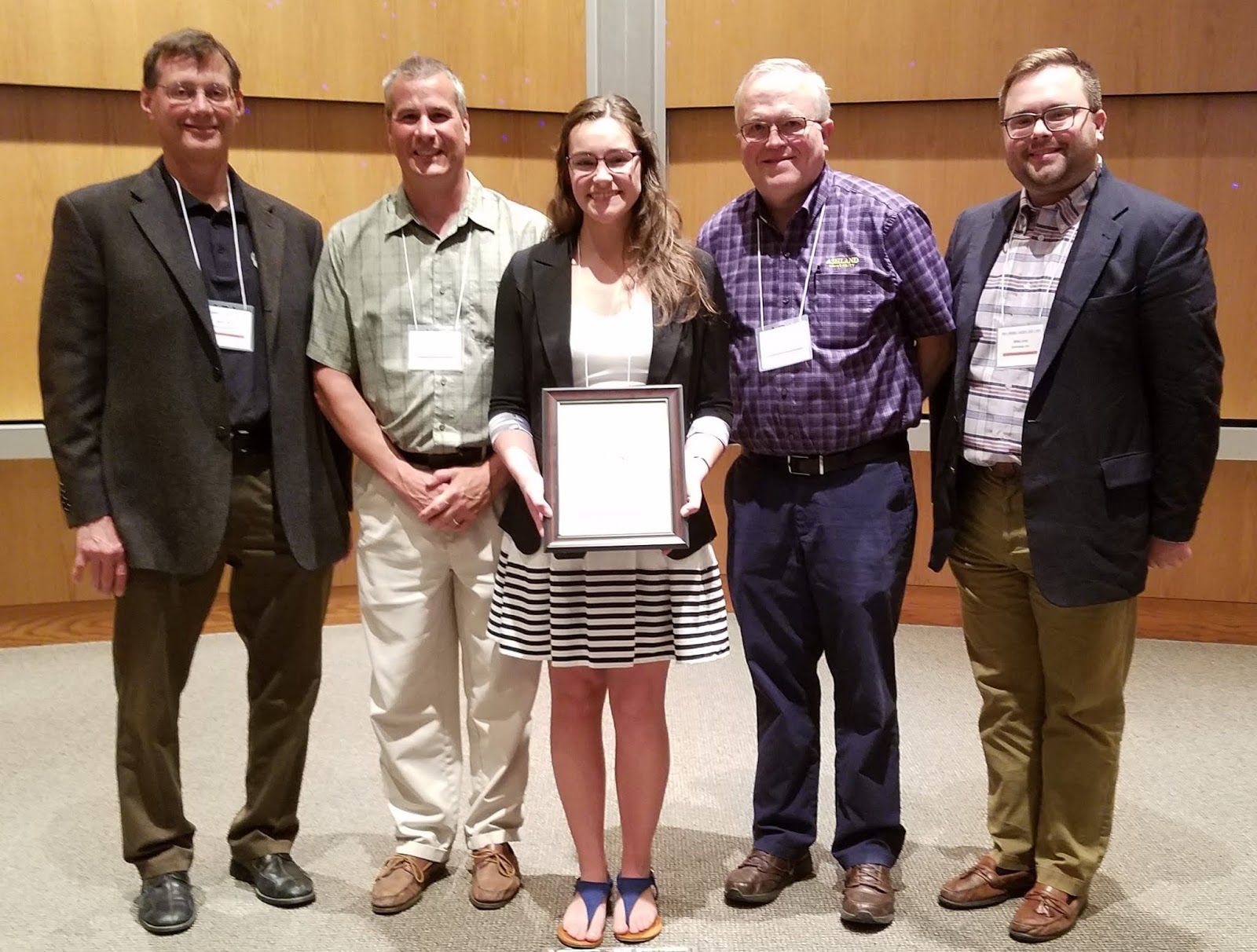
Corianna Borton ’19 (center) with adviser Dr. Brian Mohney (center left) and co-adviser Dr. Jeff Weidenhamer (center right).
May 2019 AU graduate Corianna Borton was selected as the recipient of this year’s Ernest B. Yeager award by the Cleveland Chapter of the Society for Applied Spectroscopy (SAS) and the Analytical Topics Group of the American Chemical Society (ACS).   The Yeager Award honors the memory of Ernest B. Yeager, the Frank Hovorka Professor Emeritus at Case Western Reserve University who was known for his pioneering contributions to the fundamental understanding of electrochemical reactions and to the development of fuel cell and battery technology.
The award was presented on May 22nd at the annual Conference on Spectroscopy and Analytical Chemistry at John Carroll University, where Borton gave a presentation of her research that has focused on collecting, separating and analyzing plant root exudates (harmala alkaloids) from Syrian rue in soil using silicone tube microextraction probes—a technique for repeated sampling of lipophilic compounds in soil developed in Dr. Mohney’s and Dr. Weidenhamer’s lab.  Syrian Rue releases molecules into the soil that affect the growth of other plants in the vicinity and negatively impact organisms that live in the soil near the plant.  Borton’s technique utilized silicone probes to sequester and concentrate lipophilic organic compounds allowing her to quantify the root and soil alkaloids.   Once sequestered, compounds were extracted from the silicone and the concentration of each compound was measured using ultraviolet spectroscopy (UV), fluorescence spectroscopy and high performance liquid chromatography with UV and fluorescence detection.   She has used these techniques to probe the dynamic release of harmala alkaloids from plants and to examine the effect the alkaloids have on monocot and dicot plants. The Yeager award recognizes Borton’s achievements in independent research, particularly in the application of spectroscopy to the analysis of these root exudates.  She received a certificate, a $400 monetary award and a year's membership in SAS.

This is the third time an AU student or students have been selected to win this prestigious award.  Corianna’s co-adviser, Dr. Jeff Weidenhamer, professor of chemistry, received the award as an AU undergraduate student in 1979, and Jennifer Miller Tully and Daphne Guinnwere selected as co-recipients in 2011 for their work on cadmium contamination of inexpensive jewelry.

Dr. Mohney notes, “The Yeager Award is quite an honor for both Corianna and for Ashland University.  
Corianna has been an exceptional member of Ashland University’s Honors program. She has excelled in using analytical and instrumental methods at solving research problems and has been able to perform high-level independent research at a graduate-student level since her junior year at Ashland.“ Corianna is pursuing a career in forensic science, and has been accepted into the Bowling Green State University Master’s Program in Forensic Chemistry.