Showing posts with label directed research. Show all posts

Saturday, May 16, 2026

Forensic Biology Major Rachel Stanchek receives academic athletic award

Rachel Stanchek, a rising senior Forensic Biology major, was recently recognized with the Great Midwest Athletic Conference's Women's Elite 26 Award. This annual recognition goes to one athlete from each sport in the GMAC competing at the conference championship with the highest overall GPA. Rachel was recognized in Women's Swimming and Diving, out competing nominees from 12 other schools in the conference.

Rachel presenting at URCA 2026
Rachel writes that: "It's really cool to be recognized for this, and it was not something I expected to win. In my opinion, swimming is a sport where student athletes usually take a lot of pride in academics as well as athletics. I've always been a school comes first person, so being able to prioritize my academics while still competing at the collegiate level has been a huge learning curve but also something I'm really proud of. It's always nice to see hard work pay off, but the recognition is not something I expected."

"I am still focused on a career in forensic science. My goal is to become a crime scene investigator although I think careers in criminal investigations also sound interesting. This summer I'll be coaching while I also start work on writing my honors capstone. After I complete my degree, I plan to get a job hopefully in the forensics or criminal justice field (still looking for different options!)."

Rachel recently presented her undergraduate research with AU faculty member Cindy Perkovich at our Spring URCA event.


Thursday, June 13, 2024

Alumni and student awards, new science equipment, student presentations

 We have a number of exciting news stories from this Spring semester we wanted to share:


Sunday, January 5, 2020

AU research sparks further investigation of a public health threat

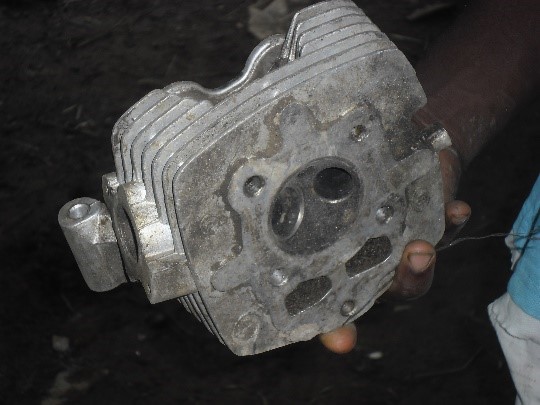
Scrap material used for cookware in 
Cameroon includes old engine parts

In 2013, Dr. Jeff Weidenhamer was contacted by Perry Gottesfeld of Occupational Knowledge International with a question about the safety of cookware.  Mr. Gottesfeld was working with colleagues at an NGO (see: http://www.crepdcm.com/) in Cameroon to reduce toxic exposures from lead paint, when questions were raised about the possible hazards of the aluminum cookware that most people there use.  In Cameroon, and throughout the developing world, the recycling of scrap aluminum into cookware is a widespread practice.  After a preliminary investigation we learned that source materials can include items such as old engine blocks, radiators, and computer parts.

Pots awaiting sale in a Cameroon market
Dr. Weidenhamer and several AU students – Peter Kobunski, Alison Biro, and Meghann Fitzpatrick – along with AU colleagues Dr. Rebecca Corbin and Dr. Michael Hudson, set out to investigate the hazards of this cookware by looking at the metals that leached from the pots in dilute vinegar solutions that mimicked mildly acidic solutions that are often used for cooking.  Working with Mr. Gottesfeld, and beginning with cookware from Cameroon and then ten other developing nations, they found a number of cookware items that released toxic levels of lead during simulated cooking.  The worst was a pot from Viet Nam that yielded more than 1400 micrograms of lead per serving.  Other metals detected in the leachates of some pots included arsenic and cadmium, and almost all of the items released levels of aluminum that exceed World Health Organization guidelines. 

The studies, which have been published in the journal Science of the Total Environment, have encouraged researchers in Cameroon, South Africa and other countries to conduct follow-up studies to assess the hazards of this cookware. 

Dr. Weidenhamer notes that it is not often that undergraduates can participate in research that has such direct and immediate impact on public health.  Two of the students involved in this work are pursuing medical careers.  Perry Gottesfeld comments, "Dr. Weidenhamer took on this research without hesitation and now we have seen these important results replicated by independent researchers in at least five countries demonstrating the significance of the work by he and his students."