Showing posts with label chemistry. Show all posts

Monday, November 8, 2021

Chemistry program is saddened by the tragic loss of alumna Danielle Wood Chronister

Danielle Wood Chronister (Chemistry, 2010) was tragically killed last week when struck by a vehicle while walking to work.  At Ashland, Danielle was active in the ACS student group, as seen in the photos below. She also worked in the chemistry stockroom, and was active in the Theatre program. Following graduation, Danielle continued her scientific training at Wright State University.  Danielle taught chemistry and engineering at the MC2STEM High School in Cleveland, and was passionate about helping her students excel.

Our deepest sympathies to her students, friends and loved ones.


Wednesday, May 19, 2021

Ashland Alumna earns Chemistry Ph.D.

 AU biochemistry alumna Mallorie Boron (’13) recently completed her Ph.D. in Clinical-Bioanalytical Chemistry at Cleveland State University.  While at Ashland, she worked with Dr. Jeff Weidenhamer to study the leaching of cadmium from inexpensive, high-cadmium jewelry and was very involved in the student American Chemical Society group.  She recently took some time to answer some questions about her Ph.D. research and how her work at AU prepared her for graduate school

What was your Ph.D. research about?

My dissertation research had two main projects. Both projects focused on thrombomodulin (TM), a protein involved in maintaining homeostasis and inflammation. In my first project I studied how THP-1 monocytes and macrophages express TM differently. TM is mostly studied in its endothelial cell form and its role in monocytes and macrophages is poorly understood. It was found that macrophages express TM in lesser amounts than monocytes. This observation led to my second project, which was to reintroduce TM to the cell surface of macrophages. Our lab has developed a recombinant form of TM that retains only its anticoagulant properties and I modified it to contain a cholesterol anchor. The cholesterol anchor allows for the recombinant TM to quickly anchor into the plasma membrane of macrophages. This potentially allows macrophages to be a cell-based anticoagulant therapeutic.

What is your current position, or your plans?

I am currently working as a visiting scientist in my graduate lab but am looking for my next job.

How did your time at Ashland prepare you for the future?

My undergraduate coursework at AU definitely gave me an edge entering graduate school. The small class sizes allow professors to engage students better and allow for a better learning atmosphere, which I directly benefitted from. The main advantage the AU science program has over other universities is its lab courses. I was able to gain critical hands-on experiences with many different instruments with engaging assignments. The ability to do independent research also strengthen my laboratory skills and strengthened my love for research. I owe a lot of my success to the AU chemistry department and the wonderful professors who taught me.

Do you have any advice for students preparing for graduate school?

My best advice for students preparing for graduate school is to find a project that you find interesting and an advisor you can communicate well with. You will be spending a lot of time with your project and it is more fulfilling if it is a story you find meaningful.

Thursday, April 8, 2021

Dr. Nick Johnson recognized for teaching excellence

Dr. Nicholas Johnson, associate professor of Chemistry in the Ashland University College of Arts and Sciences, is the recipient of AU’s 2021 Taylor Excellence in Teaching Award.  He joins a growing list of Kettering faculty who have been recognized for their outstanding teaching by winning the Taylor Award, including Dr. Perry Corbin (Chemistry), Dr. Mason Posner (Biology), and Prof. Merrill Tawse (Biology).

The Taylor Excellence in Teaching Award was endowed by the late Edward and Louaine Taylor as a way of supporting high quality teaching at Ashland University. All full-time faculty with a minimum of three years of teaching experience at AU are eligible for the award. The award committee selects the recipient after reviewing nominations from students, faculty and department chairs. This review also includes observing a class meeting of the finalist for the award. This award is one significant way in which the University recognizes faculty members in an ongoing manner for their commitment and excellent work for students.

Johnson was nominated by AU freshman biology major Maddie Fish, a student in his fall semester General Chemistry class.

“Although it was the most difficult class in terms of content, he taught in a way I had never experienced before,” Fish wrote in her nomination. “He taught in a manner so much different from any educator I have previously had. Not only does he care about his students learning the material, but he also cares about each of his students.

“I could not tell you how many times I heard him ask someone how they are doing or how school is going for them. I knew from the very first day of classes that he was a special educator because he had us fill out a slip of paper about what we would like to achieve with our degree here at AU. This really stuck out to me because he was showing how he took interest in us as people, which speaks volumes in and of itself. I never imagined that I would actually enjoy chemistry in college, but I was very wrong. His was by far my favorite class.”

 Johnson received his Bachelor of Arts from Skidmore College and his doctorate from The University of Akron and joined the Ashland faculty in 2015. His area of expertise includes the synthesis of novel inorganic compounds as well as multinuclear NMR techniques.  Prof. Johnson works with his research students on the synthesis of inorganic compounds for biomedical applications. 

Sunday, January 5, 2020

AU research sparks further investigation of a public health threat

Scrap material used for cookware in 
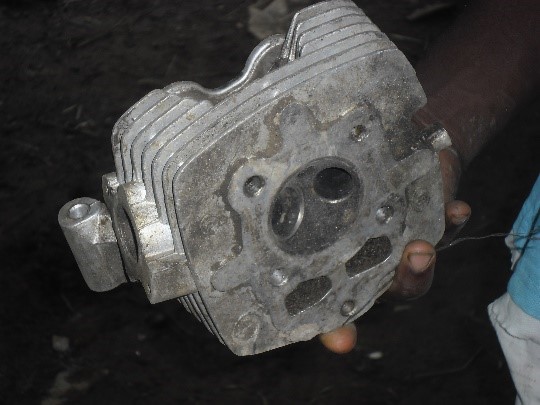
Cameroon includes old engine parts

In 2013, Dr. Jeff Weidenhamer was contacted by Perry Gottesfeld of Occupational Knowledge International with a question about the safety of cookware.  Mr. Gottesfeld was working with colleagues at an NGO (see: http://www.crepdcm.com/) in Cameroon to reduce toxic exposures from lead paint, when questions were raised about the possible hazards of the aluminum cookware that most people there use.  In Cameroon, and throughout the developing world, the recycling of scrap aluminum into cookware is a widespread practice.  After a preliminary investigation we learned that source materials can include items such as old engine blocks, radiators, and computer parts.

Pots awaiting sale in a Cameroon market
Dr. Weidenhamer and several AU students – Peter Kobunski, Alison Biro, and Meghann Fitzpatrick – along with AU colleagues Dr. Rebecca Corbin and Dr. Michael Hudson, set out to investigate the hazards of this cookware by looking at the metals that leached from the pots in dilute vinegar solutions that mimicked mildly acidic solutions that are often used for cooking.  Working with Mr. Gottesfeld, and beginning with cookware from Cameroon and then ten other developing nations, they found a number of cookware items that released toxic levels of lead during simulated cooking.  The worst was a pot from Viet Nam that yielded more than 1400 micrograms of lead per serving.  Other metals detected in the leachates of some pots included arsenic and cadmium, and almost all of the items released levels of aluminum that exceed World Health Organization guidelines. 

The studies, which have been published in the journal Science of the Total Environment, have encouraged researchers in Cameroon, South Africa and other countries to conduct follow-up studies to assess the hazards of this cookware. 

Dr. Weidenhamer notes that it is not often that undergraduates can participate in research that has such direct and immediate impact on public health.  Two of the students involved in this work are pursuing medical careers.  Perry Gottesfeld comments, "Dr. Weidenhamer took on this research without hesitation and now we have seen these important results replicated by independent researchers in at least five countries demonstrating the significance of the work by he and his students."