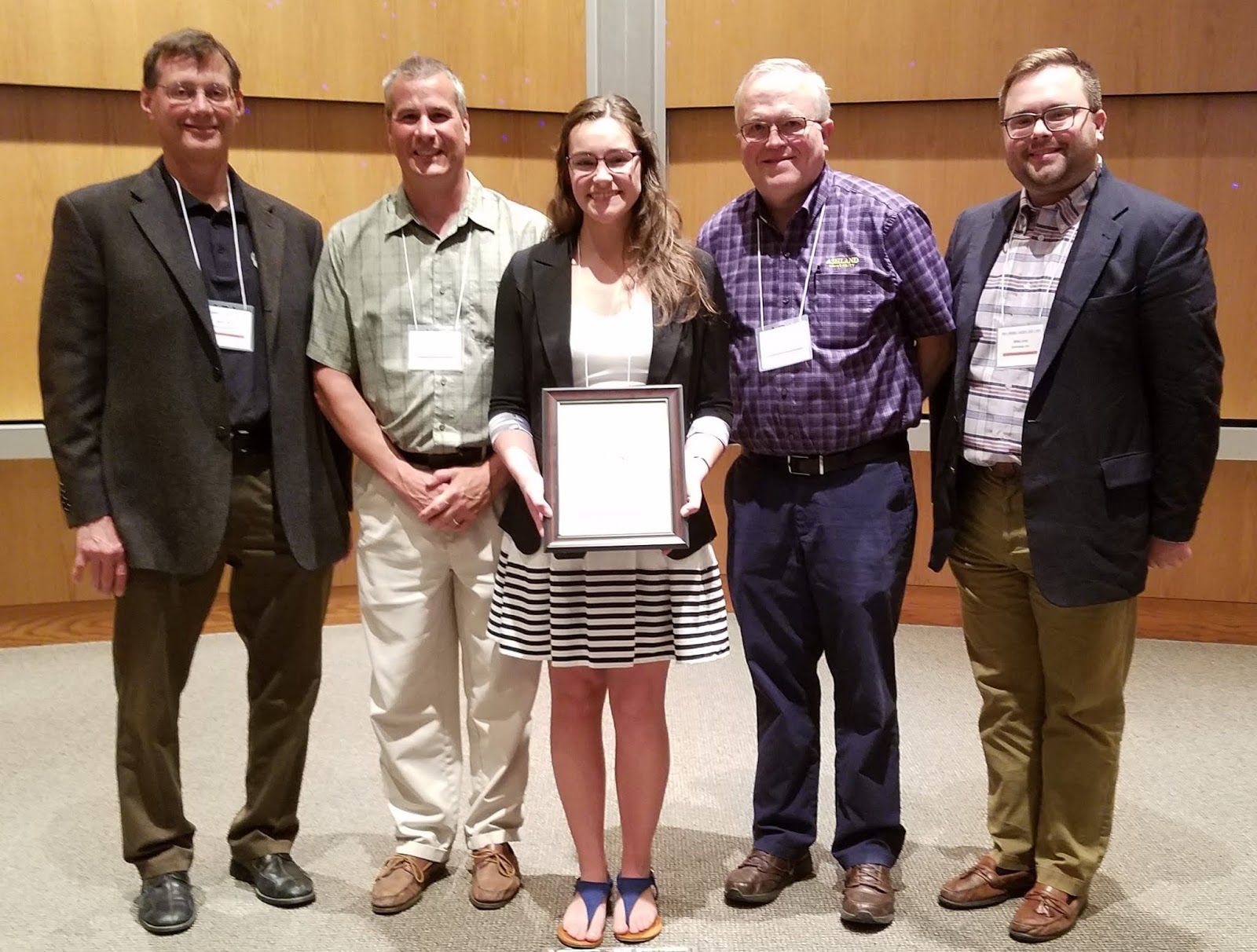
AU forensic biology and toxicology alumna Maria Kern (’20)
is the author of a recent paper on her Honors’ Thesis research, titled “Buyer
beware: Inexpensive, high cadmium jewelry can pose severe health risks.” The paper was published in the journal Science of the Total Environment, and reports the results of extractions that Maria
performed to determine how much cadmium could be released if jewelry containing
as much as 90% cadmium by weight is mouthed or swallowed. Her results show the potential for serious hazards
from this jewelry. The paper was
co-authored by Dr. Mallorie Boron, who had previously done work on the potential of
high cadmium to release cadmium when disposed of in landfills, and Dr. Jeff
Weidenhamer, who supervised the work.
Maria has kept busy in the past year, just graduating with a
Master’s degree in Toxicology from Wright State. This program focused on Leadership in science,
and she found that it greatly improved her leadership, communication, writing,
and presentation skills. Maria offered some comments on her experience at
Ashland.
What
was the most valuable aspect of working on your research project?
The
two most valuable aspects of this research project were the technical skills
and the confidence that I gained from completing the project. I learned so much
over the course of this project about how to conduct research in the lab,
develop timelines, set deadlines, record data for later use, and how to combine
everything into a paper that was eventually published. I also learned many
technical skills specific to laboratory methods, instrumentation, data
analysis, quality control, and even cleaning that will be used throughout my
entire career as a scientist. Upon completing the project, I gained much more
confidence in myself and my abilities as a scientist. It really proved to
me that I was capable of completing extended research projects and then
publishing the data for the rest of the scientific community and the word to
see.
How
did your time at Ashland prepare you for the future?
Without
my time at Ashland, I do not think I would be where I am today. Because of the
small class sizes, I got lots of hands on experience in the lab, and formed
close relationships with several of my professors, making it easy to ask for
help when I needed it. During my time in the Honors Program, I completed a
three-semester long research project, which instilled me with many
technical skills that will be useful during the rest of my career as a
scientist.
What were the highlights of the AU
Science Program for you?
The small class sizes and the abundant research
opportunities are both highlights of the AU science program. Small class sizes
allow for a free flow of ideas during class discussions, as well as allowing
students and professors to form relationships outside of the classroom. Smaller
class sizes and better relationships with professors also make it easier to ask
for help or get further clarification on subjects you may be struggling with.
The research opportunities at AU are remarkable, and really sets AU apart from
other universities. There are numerous projects going on at any given time, in
many different majors. This ensures that any interested student can participate
in extra research and learn hand-on skills if they are interested.Both of these
are huge highlights of the science program at AU and some of the reasons that I
chose to attend AU. They are also both reasons that I will now recommend the AU
science program to anyone who asks, and something that I will always be
grateful for participating in.